PSEA Declaration & UN Compliance Requirements Guide
Published July 4, 2026
Buried in the general conditions of many UN tenders, past the technical requirements and pricing forms, is a short but non-negotiable ask: acknowledge, and sometimes actively demonstrate, compliance with the UN's Protection from Sexual Exploitation and Abuse (PSEA) standards. It's easy to treat as boilerplate. Skip it, and an otherwise strong bid can be flagged as incomplete before anyone reads your technical proposal.
What is PSEA, and why does it show up in UN tenders?
PSEA is a system-wide UN commitment to preventing and responding to sexual exploitation and abuse by UN staff, implementing partners, contractors, and vendors connected to UN-funded work. It grew out of reforms across the UN system aimed at closing gaps where partners and suppliers operated without the same accountability standards as UN staff themselves. In practice, that means procurement is one of the places PSEA commitments get enforced: agencies extend their PSEA obligations down through their supply chain by requiring vendors to acknowledge, and in some cases actively support, those standards as a condition of doing business with them.
What UN agencies typically ask suppliers to declare
Requirements vary by agency and contract, but the most common asks fall into a few categories:
- A signed PSEA declaration or certification, confirming awareness of the UN's zero-tolerance policy on sexual exploitation and abuse and agreement to comply with it.
- Acknowledgment of the UN Supplier Code of Conduct, which typically bundles PSEA alongside broader ethical, labor, and anti-corruption standards.
- Evidence of an internal PSEA policy, required more often for higher-value contracts or work involving direct contact with vulnerable populations, such as humanitarian, education, or child-protection programming.
- A designated PSEA focal point, sometimes required for larger implementing partners rather than product or equipment suppliers.
Do you need an actual PSEA policy, or just a signed declaration?
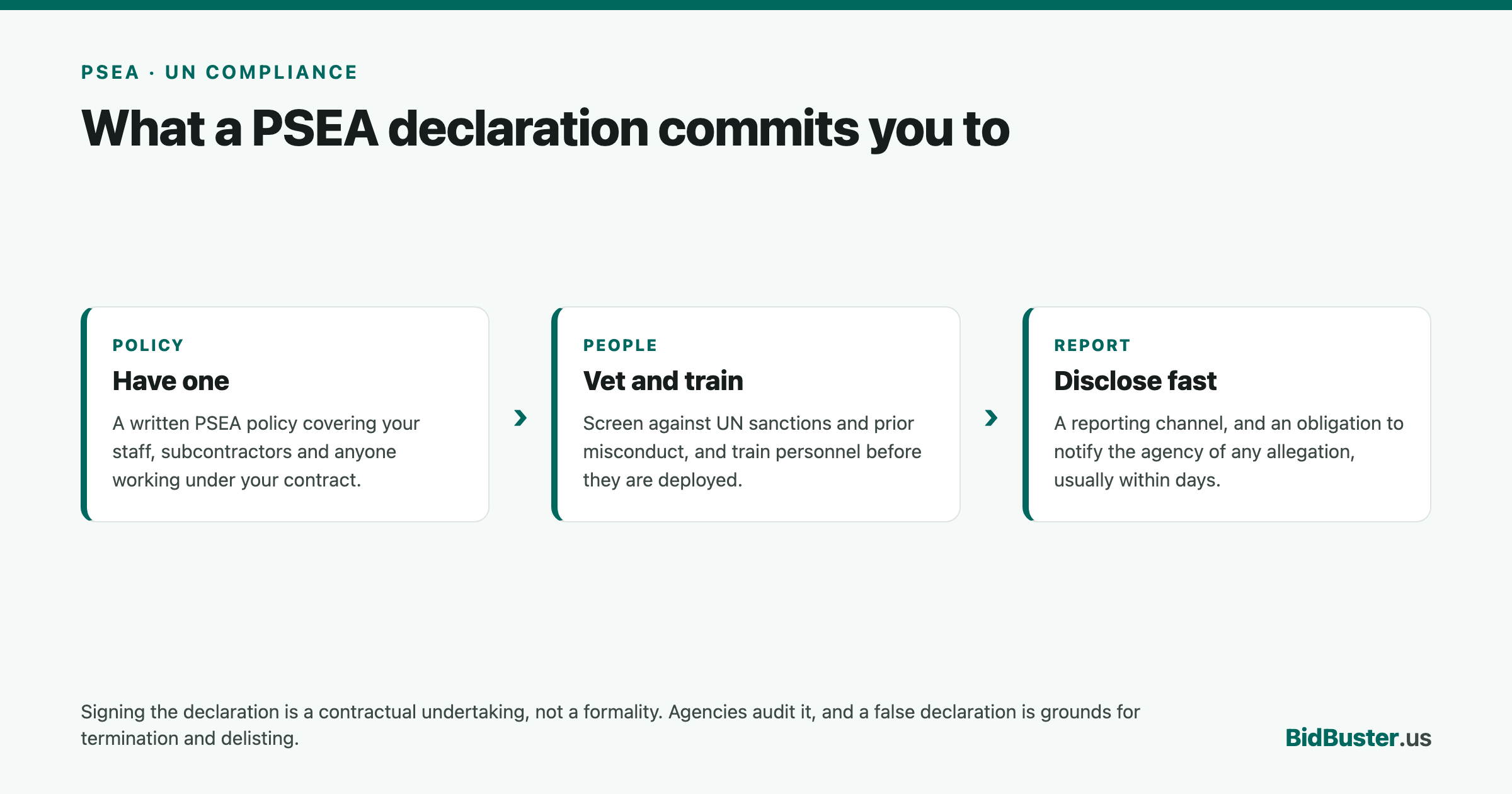
This is the detail that trips up smaller contractors. For most straightforward goods-and-services contracts, a signed declaration acknowledging the standards is sufficient. But for contracts involving fieldwork, direct beneficiary contact, or larger dollar values, agencies may expect your organization to already have a written PSEA policy, a way for people to report concerns, and some evidence you've communicated the policy internally. Read the specific tender's requirements rather than assuming last year's declaration format still applies. Requirements have been tightening across the UN system, not loosening.
How PSEA fits with other UN compliance declarations
PSEA rarely stands alone. It's typically one line item in a cluster of declarations UN tenders expect alongside it: anti-fraud and anti-corruption certifications, conflict-of-interest disclosures, sanctions and denied-party screening acknowledgments, and sometimes a bankruptcy or debarment attestation. Treat these as a single compliance block to gather and complete together rather than hunting for each one separately as you work through the tender document.
Common mistakes suppliers make
- Assuming it doesn't apply to non-fieldwork contracts. Many agencies apply PSEA declarations to nearly all supplier contracts, not just ones with direct beneficiary contact.
- Reusing an old declaration without checking the current form. Agencies update these documents, and submitting an outdated version can be treated the same as submitting none at all.
- Missing it because it's in the general conditions, not the main RFP body. PSEA requirements are frequently in an annex or standard terms document referenced by the tender, not the tender narrative itself.
- Claiming a policy you don't actually have. If a tender requires evidence of an internal PSEA policy and you don't have one, address it honestly rather than submitting an unsupported claim. Some agencies verify.
Checklist before you submit
- Search the full tender package, including annexes and general conditions, for "PSEA," "sexual exploitation," and "Code of Conduct."
- Confirm whether a signed declaration is sufficient or whether an actual policy and focal point are expected.
- Complete PSEA alongside your other standard declarations (anti-fraud, sanctions, conflict of interest) in one pass.
- Use the current version of the declaration form referenced in this specific tender, not a saved copy from a past submission.
BidBuster's regime checklist flags PSEA declarations and Code of Conduct acknowledgments automatically as part of decoding a UN tender, alongside whatever the solicitation states explicitly, so this requirement doesn't depend on someone remembering to check the annex.
Frequently asked questions
What does PSEA stand for?
PSEA stands for Protection from Sexual Exploitation and Abuse. It's a UN system-wide policy area aimed at preventing and responding to sexual exploitation and abuse by UN personnel, implementing partners, and vendors working on UN-funded activities.
Is a PSEA declaration required for every UN tender?
Not universally, but it's increasingly common, especially for agencies with field operations and implementing-partner relationships such as UNICEF, UNDP, WFP, and UNOPS. Check the tender's general conditions and required forms rather than assuming it doesn't apply.
Do I need an actual PSEA policy in place, or is signing a declaration enough?
It depends on the contract's size and risk profile. Lower-value, low-risk contracts often only require a signed declaration acknowledging the UN's PSEA standards and the Supplier Code of Conduct. Larger or higher-risk contracts, particularly ones involving direct contact with vulnerable populations, may require evidence of an actual internal PSEA policy, a designated focal point, or a reporting mechanism.
What happens if I skip the PSEA declaration?
Treat it as a mandatory gate, not an optional extra. Missing a required declaration is one of the most common reasons a technically strong bid gets flagged as non-compliant, since evaluators typically check submission completeness before they ever score technical merit.