Two-Envelope Submissions Explained (UN Tenders)
Published July 4, 2026
If you've registered on UNGM and responded to a few UN tenders, you've likely run into a requirement to submit your proposal in "two envelopes": one technical, one financial. It's not a formality. Get it wrong, and the most common mistake in this format doesn't just cost you points. It can disqualify your bid outright. Here's what the two-envelope system actually is, why UN agencies use it, and how to submit one without tripping the wire.
What is a two-envelope submission?
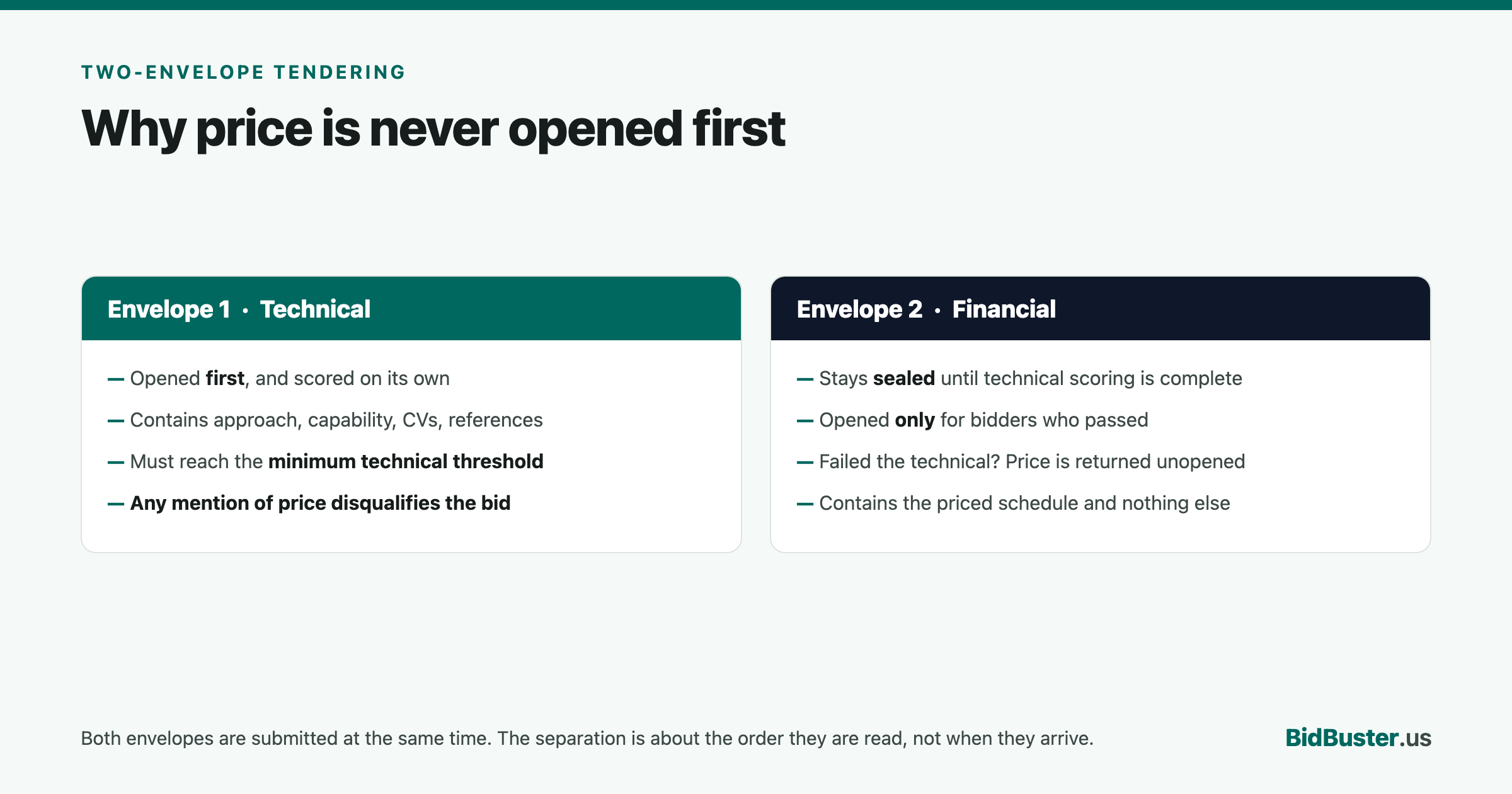
A two-envelope (sometimes called two-part or technical/financial) submission splits your proposal into two separate, independently sealed components submitted at the same time:
- The technical envelope: your approach, methodology, qualifications, past performance, and personnel. No pricing information of any kind.
- The financial envelope: your pricing proposal, submitted separately and not opened until the technical evaluation is complete.
The evaluators scoring your technical envelope never see your price while they're doing it. That's the entire point.
Why UN agencies use this structure
Procurement rules exist to keep evaluation fair and defensible. If technical evaluators know a bidder's price while scoring their methodology, price can, consciously or not, color the technical score. A cheaper bidder might get graded more generously; a more expensive one more harshly. Separating the two envelopes removes that bias: the technical proposal is judged purely on its own merits, and price only enters the picture afterward, for bidders who've already proven they can do the work.
How the evaluation actually works
- Both envelopes are submitted together, by the same deadline, but sealed and labeled separately.
- Only the technical envelopes are opened first. Evaluators score each bidder against the stated technical criteria.
- Many UN tenders apply a technical threshold: a minimum score, often somewhere around 70%, that a bidder must clear. Bidders below the threshold are eliminated at this stage, regardless of price.
- Only for bidders who cleared the threshold are the financial envelopes opened. The evaluation weights (for example, 70% technical / 30% financial) are then applied to produce a final combined score.
- The bidder with the best combined score, among those who passed the technical gate, wins.
The mistake that gets bids disqualified: price leaks
The single most common, and most avoidable, error in two-envelope submissions is letting pricing information slip into the technical envelope. It happens more easily than you'd think: a project timeline that includes a cost breakdown, a staffing plan with daily rates attached, a past-performance reference that mentions a contract value. Any of these can be read as disclosing price before the technical evaluation, and most UN agencies treat that as a serious compliance failure: in many cases, an automatic disqualification, independent of how strong the rest of the technical proposal is.
Before you submit, scan your entire technical package specifically for dollar figures, rate cards, cost tables, and anything that could be read as pricing, not just the sections you think of as "the proposal."
Two-envelope vs. three-envelope systems
Most UN tenders use two envelopes. Some national public-works and multilateral-bank-funded procurement systems use a three-envelope structure instead, adding a separate eligibility or pre-qualification envelope (registration status, bonding capacity, basic eligibility documents) that's opened and cleared before the technical envelope is even considered. If a tender document uses unfamiliar envelope terminology, don't assume it maps directly onto the two-envelope UN model. Read the instructions to bidders section carefully, since the number and order of envelopes changes what gets evaluated when.
Checklist for a compliant two-envelope submission
- Confirm the tender actually requires two envelopes, and note the exact technical threshold and evaluation weights if stated.
- Scan the entire technical envelope for pricing information, including staffing rates, cost tables, and contract values in past-performance references.
- Label and package each envelope exactly as instructed. File naming and submission-portal conventions vary by agency.
- Submit both envelopes by the same deadline; a late financial envelope from an otherwise on-time bidder can still be rejected.
- Keep a copy of exactly what you submitted in each envelope, in case a compliance question comes up during evaluation.
- Complete any required PSEA and Code of Conduct declarations alongside your technical envelope, since they're usually due with the same submission.
BidBuster detects when a tender requires a two-envelope split and builds two separate submission packages automatically (a technical package and a financial package) and runs a price-leak scan on the technical package before it's finalized, stripping out any dollar figures that slipped in and flagging them in the QA report.
Frequently asked questions
What is a two-envelope submission?
A procurement method where technical and financial proposals are submitted separately and evaluated in sequence: the technical envelope first, then the financial envelope only for bidders who pass the technical evaluation. It keeps price from influencing the technical assessment.
What happens if pricing information appears in the technical envelope?
It's treated as a serious compliance failure by most UN agencies, and can result in outright disqualification, since the entire point of the two-envelope structure is to keep the technical evaluators blind to price. This is one of the most common, and most avoidable, mistakes in UN tender responses.
What is a technical threshold?
A minimum technical score (for example, 70%) a bidder must reach before their financial envelope is even opened. Bidders who fall short are eliminated regardless of price, so a technically weak but cheap bid can't win purely on cost.
Is the two-envelope system the same as a three-envelope system?
No. A three-envelope system adds a separate eligibility or pre-qualification envelope (verifying registration, bonding, or basic eligibility) that's opened before the technical envelope. Most UN tenders use two envelopes; three-envelope structures are more common in some national public-works procurement systems.